Jane Tucker School for the Blind
Bird BoxJane Tucker School for the Blind is the community and refuge that Malorie reaches with her children after their escape by river. Its illuminated halls and organized, self-sufficient life mark a decisive change in the terms of survival: protection need no longer mean remaining blindfolded and isolated, or treating blindness as the only possible defense.
Identity and Setting
The school is introduced to Malorie as Tucker, the facility where its residents live. The building is an enormous school with high ceilings, domed light panels, long brick corridors, bulletin boards, desks, and glass cases. Although there are no windows, its fresh-feeling air and clean, cool floors distinguish it sharply from the makeshift and increasingly dangerous domestic spaces Malorie has left behind. The lights are so bright that, when she first opens her eyes, she can barely keep them open.
The name over a brick arch identifies the place as Jane Tucker School for the Blind. The institutional name is not merely a label: it sets the school apart as a functioning settlement organized around the needs of blind residents. Handwritten banners record progress in recovery, while posted flyers list daily assignments for farming and water purification and a medical-evaluation schedule filled with appointments. The corridors therefore reveal an operating community, not simply a building that offers temporary shelter.
Arrival and First Impressions
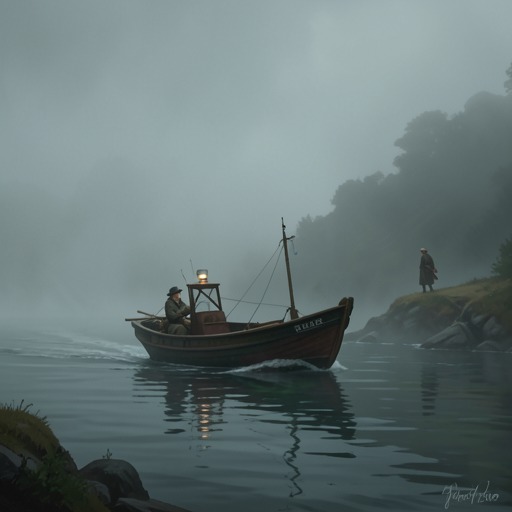
Constance helps Malorie out of the boat and takes the children first, clasping their hands as she guides the group toward the facility. She carries a gun and apologizes for it, a small sign that the school’s welcome exists alongside caution. Malorie has spent years navigating the world with her eyes covered; on entering, she tugs at her blindfold and slowly opens her eyes to the harsh light.
Rick is there to receive them. His eyes are open but unfocused, glassy and gray, and a deep, faded scar near his left eye is visible beneath his long brown hair. He uses a worn wooden walking stick, bent from a broken tree limb. When Malorie recognizes that he is blind, Rick confirms that many residents are too, while noting that Constance can see. His scar, stick, and unseeing gaze make the school’s history legible in his body before he explains its policies.
The children’s first moments inside extend the contrast between arrival and the life before it. Malorie removes their blindfolds; the Boy and Girl stare at the bright space, blinking, quiet, and unsure, looking to their mother for guidance. It is the first place outside the house they have seen in their entire lives. They do not cry or complain, but listen as they look around. The school is thus not only their destination: it is the first setting in which their experience of the world can begin to exceed the house, the river, and the sounds by which Malorie has trained them to survive.
Organization and Self-Sufficiency
Rick describes a community with practical systems for sustaining its residents. Tucker grows its own food and has captured animals: chickens provide fresh eggs, a cow provides milk, and two goats may be bred. The residents hope eventually to search for more animals and develop a small farm. These details give self-sufficiency a concrete scale, from existing livestock and food to a future plan for expanding the farm.
The facility also has a medical team devoted to rehabilitating people who are blind. Along with the visible evaluation schedule and assignments for water purification, this care places recovery within a shared routine rather than leaving it to individual improvisation. The school’s order is practical and collective: work is assigned, food is produced, water is treated, and residents receive medical attention. Rick says the place brings him peace, presenting that peace as the result of a lived system of support rather than as freedom from all danger.
Blindness, Security, and the Old Way
Tucker’s present safety is shaped by an earlier catastrophe. Rick recalls that residents once hunted for food before they had the security they now possess. During one such outing, a creature entered the school. Many people were killed; a mother who had been rational suddenly became violent and killed four children. The community took months to recover and rebuild, and resolved not to risk a similar breach again.
In that earlier period, residents blinded themselves with whatever was available, including forks, kitchen knives, or their fingers. Rick calls blindness their absolute protection and describes it as the old way. After a year, the community judged that it had fortified the facility sufficiently to ease that burden; Rick says there have been no security lapses since. His account makes the school’s policy a historical response to specific loss, while also distinguishing its former dependence on self-blinding from its current, more secure arrangement.
Malorie responds to this history through memories of George’s video and failed experiments, and of nearly blinding her own children in desperate sacrifice. The school’s alternative matters in light of those earlier possibilities: its residents include blind people, but its stated security no longer demands that every newcomer inflict blindness on themselves or their children. The shift does not erase the community’s losses or make its precautions needless; it shows how collective fortification has changed what protection can require.
A Different Future
Tucker’s importance becomes clearest in the contrast between its organized interior and the spaces Malorie has crossed to reach it. The house and river have governed her life through enclosure, danger, and forced vigilance. Inside the school, residents emerge from different rooms as Rick places a hand on Constance’s shoulder and they begin walking farther into the facility. The people allow Malorie and the children a moment together; the scene presents safety not as a solitary escape but as an environment maintained by a community.
That promise remains measured. Malorie’s final sense is that they are safe, then immediately, more cautiously, safer. Tucker offers her children living animals beyond fish, a medical team, food production, and the company of others, but arrival does not undo the years of danger that made the refuge necessary. Its decisive significance lies in opening a different possibility: survival can be organized through shared resources and improved security, so that a mother and children who have known only the house and the river may begin to inhabit a larger world.